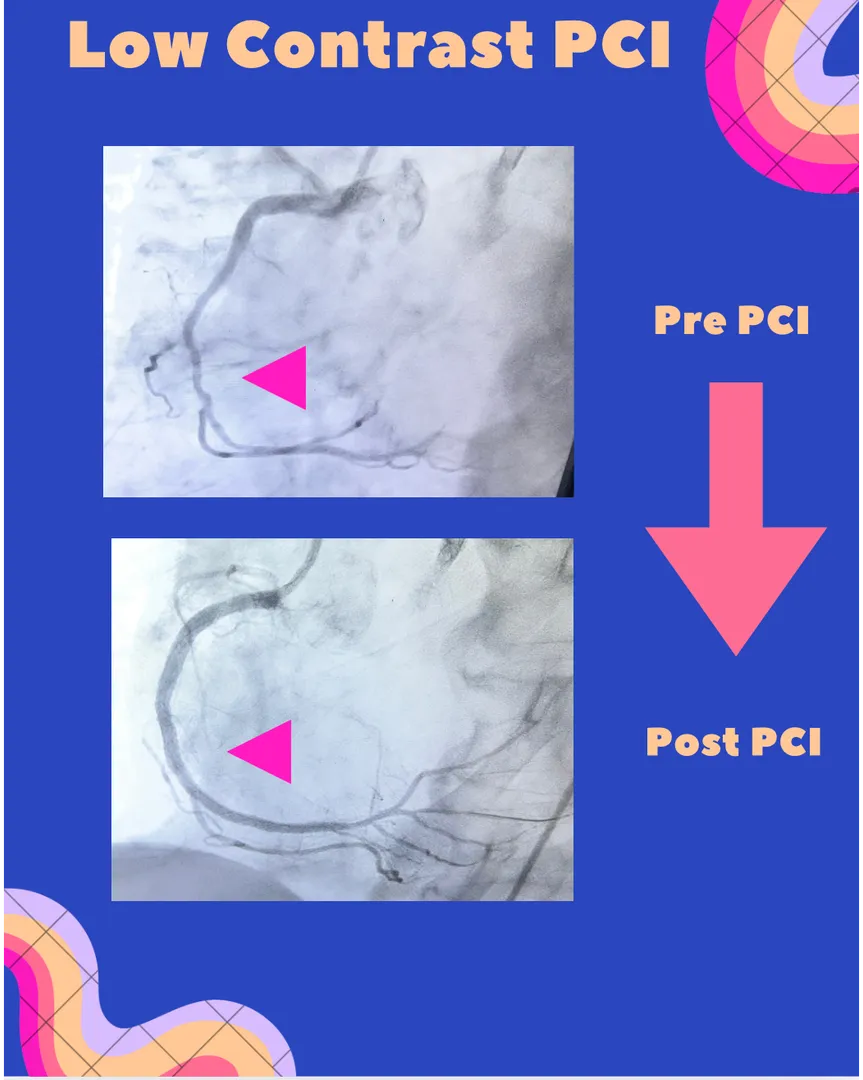
Treating blocked heart arteries in patients with chronic kidney disease (CKD) can be challenging—because the contrast dye used during angioplasty can further harm the kidneys.
💡 Here’s where Low Contrast angioplasty makes a difference.
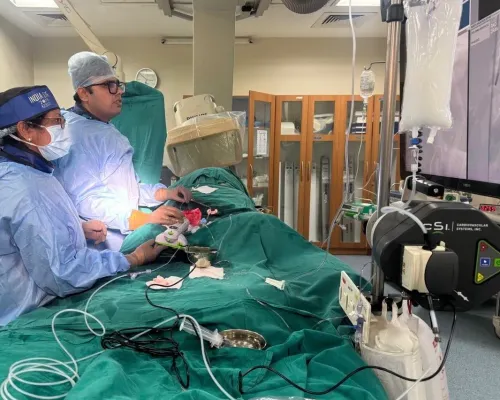
Recently, in a patient with Kidney Disorder and a heavily calcified artery, a complex heart procedure was successfully performed using:
✔️ Minimal contrast dye to protect kidney function.
✔️ FFR (Fractional Flow Reserve) to accurately assess the severity of the blockage without excess dye
✔️ Guide extension catheter for better device delivery in a tough, calcified blockage
This patient had Creatinine of 5.9 g/dl when this procedure was performed and wanted to avoid dialysis as much as possible. So this procedure was performed with accuracy, precision and Safety & patient was discharged on Day 3 following procedure.
🔍 Why this approach matters:
• Reduces risk of contrast-induced kidney injury
• Enables safe treatment of complex, calcified arteries
• Uses physiology (FFR) to guide precise decision-making
• Improves outcomes in high-risk patients
⚠️ Kidney patients undergoing angioplasty need special care and techniques like low contrast PCI are changing the game.
👉 A great example of how modern cardiology balances precision + safety, especially in vulnerable patients.
💬 If you or a loved one has kidney disease and heart blockage, ask your cardiologist about kidney-safe angioplasty techniques, or contact us at Anahatheartcenter.com, drrajeshmattacardio.com
#CKD #HeartHealth #Angioplasty #LowContrastPCI #FFR #InterventionalCardiology #PatientSafety #CalcifiedLesions #MedicalInnovation
💡 Here’s where Low Contrast angioplasty makes a difference.
Recently, in a patient with Kidney Disorder and a heavily calcified artery, a complex heart procedure was successfully performed using:
✔️ Minimal contrast dye to protect kidney function.
✔️ FFR (Fractional Flow Reserve) to accurately assess the severity of the blockage without excess dye
✔️ Guide extension catheter for better device delivery in a tough, calcified blockage
This patient had Creatinine of 5.9 g/dl when this procedure was performed and wanted to avoid dialysis as much as possible. So this procedure was performed with accuracy, precision and Safety & patient was discharged on Day 3 following procedure.
🔍 Why this approach matters:
• Reduces risk of contrast-induced kidney injury
• Enables safe treatment of complex, calcified arteries
• Uses physiology (FFR) to guide precise decision-making
• Improves outcomes in high-risk patients
⚠️ Kidney patients undergoing angioplasty need special care and techniques like low contrast PCI are changing the game.
👉 A great example of how modern cardiology balances precision + safety, especially in vulnerable patients.
💬 If you or a loved one has kidney disease and heart blockage, ask your cardiologist about kidney-safe angioplasty techniques, or contact us at Anahatheartcenter.com, drrajeshmattacardio.com
#CKD #HeartHealth #Angioplasty #LowContrastPCI #FFR #InterventionalCardiology #PatientSafety #CalcifiedLesions #MedicalInnovation
Keywords