An inferior vena cava filter may be placed when a patient has a substantial risk of pulmonary embolism but cannot safely receive standard anticoagulant treatment. Some filters are intended to remain permanently, while many modern devices are designed to be retrieved once the temporary need for protection has passed.
For this reason, IVC Filter Removal should be considered as part of the original treatment plan rather than as an unrelated procedure months or years later.
Patients in Navi Mumbai who previously underwent IVC filter placement should understand when reassessment is appropriate and why unnecessary delay can sometimes make retrieval more challenging.
Why Would an IVC Filter Be Removed
An IVC filter sits inside the inferior vena cava and helps intercept certain clots travelling from the lower body toward the lungs.
If the original reason for placement resolves, leaving a retrievable filter indefinitely may provide limited additional benefit while exposing the patient to potential long-term device-related complications.
Removal may be evaluated when:
- The risk of pulmonary embolism has decreased
- Anticoagulant treatment can safely be restarted
- The temporary contraindication to blood thinners has resolved
- The patient has recovered from the condition that required temporary protection
- The treating team determines that continued filtration is unnecessary
The decision is based on the patient's current condition rather than simply the amount of time since implantation.
What Should Be Checked Before Retrieval
Before attempting removal, the specialist reviews the original reason for filter placement and the patient's current risk of venous thromboembolism.
Relevant evaluation may include medical history, blood tests and imaging.
The team may also need information about:
- Filter type
- Date of implantation
- Original implantation report
- Previous imaging
- Current anticoagulant medicines
- Recent episodes of deep vein thrombosis
- Previous pulmonary embolism
- Ongoing bleeding risk
Patients who have records from the original procedure should bring them to their consultation whenever possible.
How Retrieval Is Usually Performed
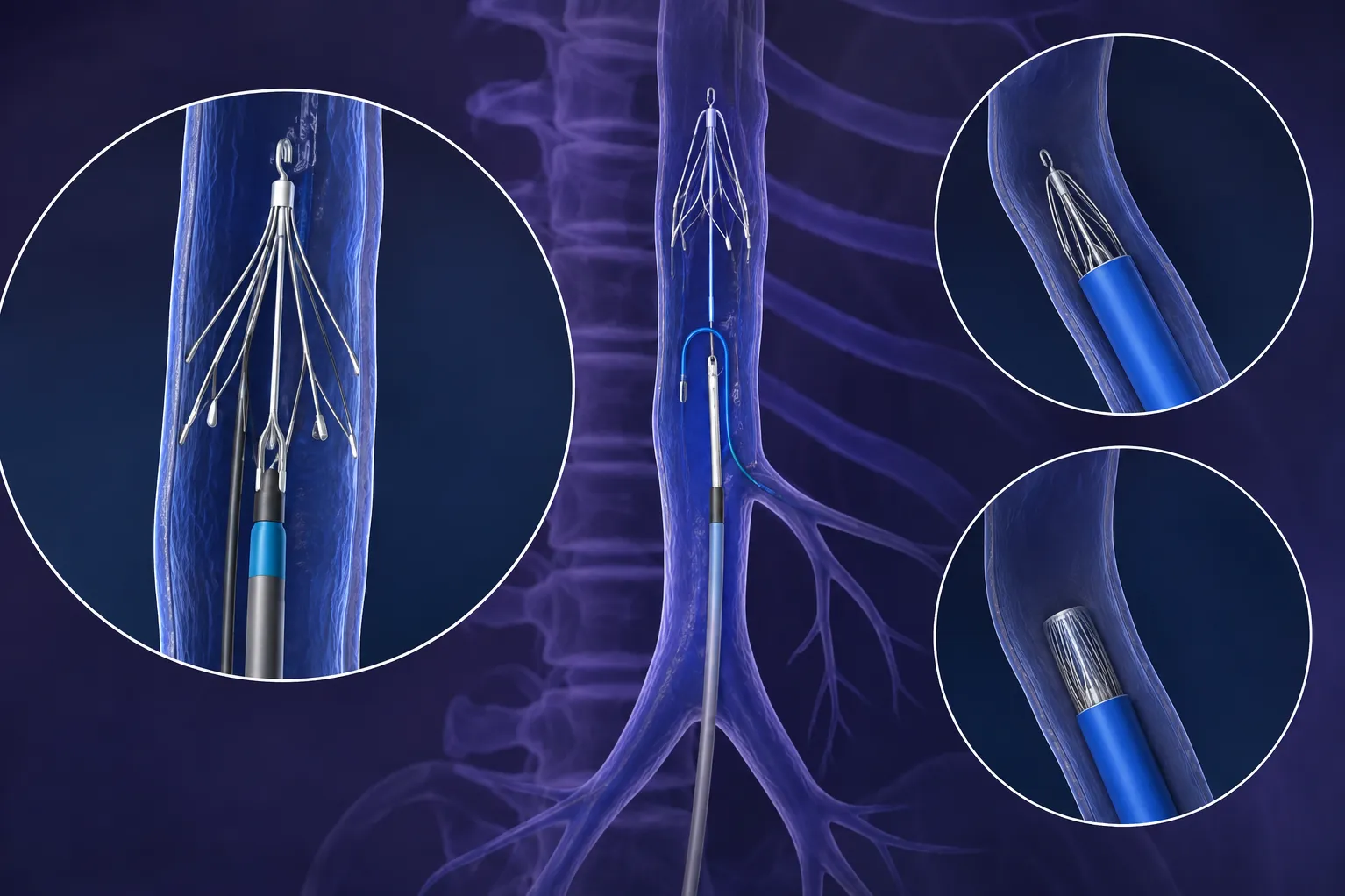
IVC Filter Removal is commonly performed through a minimally invasive catheter procedure.
Vascular access is obtained through an appropriate vein. A catheter-based retrieval system is then guided toward the filter under imaging guidance.
The filter is captured, collapsed into a sheath and removed through the vascular access site.
Some filters can be retrieved relatively straightforwardly. Others may become tilted, embedded in the vein wall or difficult to capture after remaining in place for an extended period.
These situations can require more advanced retrieval planning.
Why Delayed Follow-Up Can Matter
One common problem is that patients forget about a retrievable filter once the original medical emergency has passed.
Longer dwell time does not automatically mean a filter cannot be removed. However, certain filters can become more difficult to retrieve over time.
Potential issues associated with long-term filter presence include:
- Filter-related thrombosis
- Device migration
- Fracture of filter components
- Penetration beyond the vein wall
- Increasing technical difficulty during retrieval
This is why scheduled reassessment is valuable.
Questions Worth Asking at Your Consultation
If you have an IVC filter, ask whether the device is retrievable and whether the medical reason for keeping it is still present.
It is also useful to ask what imaging is required, whether anticoagulant treatment needs adjustment and what happens if standard retrieval is difficult.
For patients in Navi Mumbai and surrounding areas of Maharashtra, a consultation with an interventional cardiovascular specialist can clarify these issues before a retrieval attempt is planned.
At Anahat Heart Center, Dr. Rajesh Matta assesses patients requiring cardiovascular interventions, including evaluation related to IVC filters. Appropriate IVC Filter Removal depends on understanding both the device and the patient's current clotting risk. The goal is to remove a retrievable filter when clinically appropriate without compromising protection against venous thromboembolism.
Keywords